




Trusted EV charging solutions across Hampshire
Reliable EV charging is now a practical necessity for Hampshire homes and businesses looking to electrify fleets, welcome customers with electric vehicles, or offer simple, convenient home charging. This guide explains the real benefits, typical costs, available workplace grants and the charger types that work best for domestic and commercial sites in Hampshire. You’ll get clear guidance on calculating commercial return on investment, the main drivers of installation pricing, how the OZEV Workplace Charging Scheme and other funding routes operate, and which charger technologies suit different use-cases. We also compare Level 2 and DC rapid chargers, walk through a step-by-step grant application process, and outline maintenance and long-term support expectations for managed networks. Where it helps, we call out local considerations for places such as Fleet and Basingstoke and include practical tips for commissioning trusted installers in Hampshire.
What are the business benefits of installing commercial EV chargers in Hampshire?
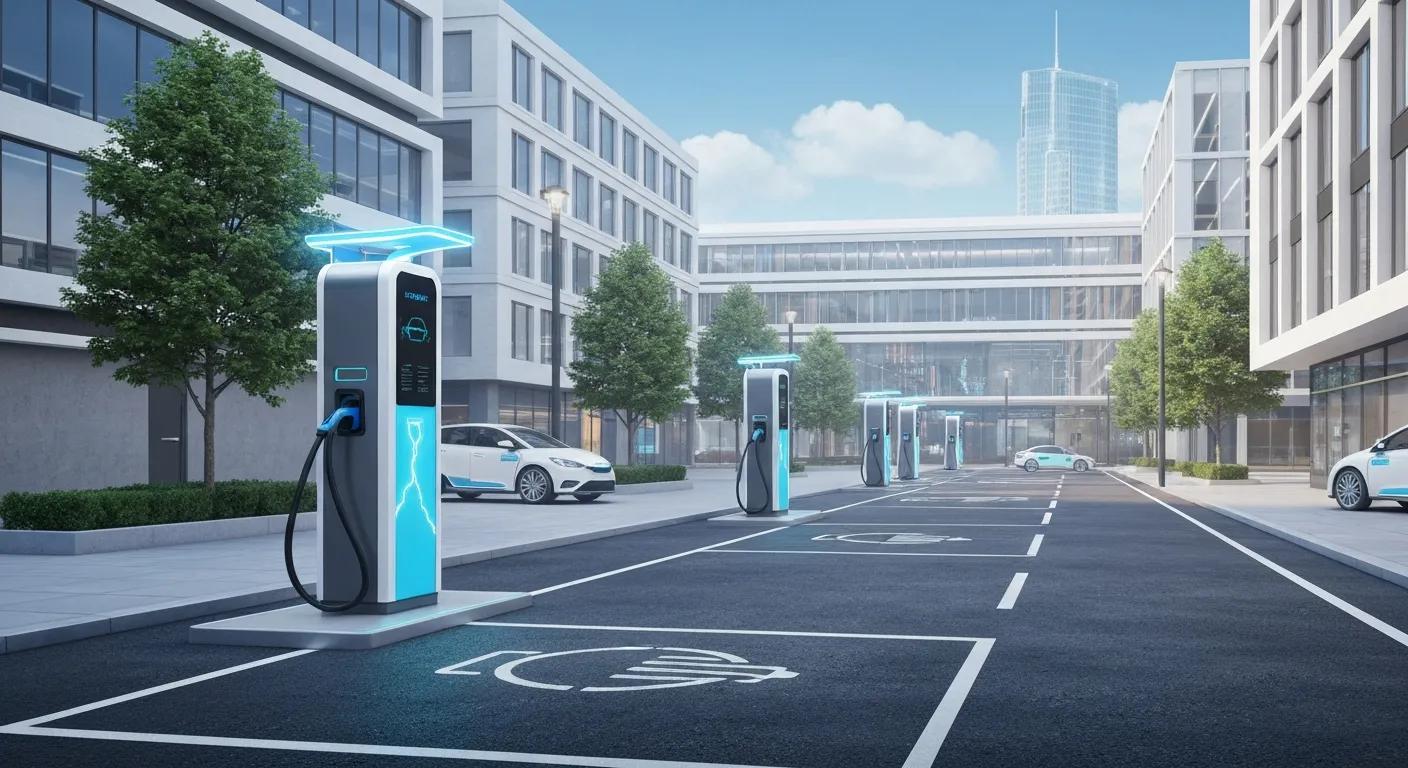
Commercial EV charger installation across Hampshire delivers measurable advantages for organisations focused on sustainability, employee wellbeing and customer experience. Workplace and customer chargers support ESG targets, make fleet decarbonisation feasible and open new revenue channels through paid charging or longer visitor dwell times. Onsite charging also improves readiness for local delivery fleets and signals a forward-thinking brand to customers and staff. The short list below summarises the main business benefits and shows how they translate into revenue and sustainability outcomes.
Hampshire businesses typically see both direct and indirect gains from installing chargers:
- Revenue generation: Charging fees or session-based access create incremental income per bay.
- Staff attraction and retention: Onsite charging is a valued workplace perk that supports recruitment and retention.
- Customer convenience: Visitor chargers increase dwell time and encourage local spending.
- ESG and brand value: Visible charging infrastructure strengthens sustainability reporting and procurement credentials.
These outcomes form the basis for quantifying how EV chargers can improve sustainability metrics and benefit the bottom line for local companies.
How can EV chargers improve business sustainability and revenue?
Commercial EV chargers reduce on-site emissions and enable cleaner fleet operations, supporting corporate reporting and net-zero planning. Lower tailpipe emissions for company vehicles and staff commutes feed into Scope 1 and Scope 3 figures, improving ESG scores and making organisations more attractive to partners and customers. On the revenue side, chargers can operate pay-as-you-go, subscription models, or offer free visitor charging that drives ancillary sales. Simple forecasts—for example, average sessions per socket per week multiplied by a session fee—give businesses a quick way to estimate payback and prioritise investment in electrification.
Estimating uptake and likely income does require a site survey and realistic usage assumptions, which vary by sector and location. The next section explains why working with an approved, experienced installer simplifies compliance, warranty management and grant access so sustainability and revenue targets are met reliably.
Why choose approved EV charger installers in Hampshire?
Using an approved installer guarantees safe, regulation-compliant work and preserves manufacturer warranties that protect long-term asset value. Approved teams maintain manufacturer relationships and know the technical checks needed for OZEV grant validation and post-installation compliance. Professional installers fit correct earthing, metering and load-management solutions to avoid unexpected costs and make sure chargers integrate with site energy systems. Choosing a skilled local installer reduces project risk, smooths maintenance scheduling and increases confidence in uptime and reliability.
Understanding installer responsibilities and approvals naturally leads into cost considerations, since correct installation practice affects total installed cost and future operating expenses for both domestic and commercial projects.
For Hampshire organisations ready to act, Downlight Electrical Ltd is an approved installer serving domestic and commercial clients across the South of England, including Hampshire, Surrey and London. We offer survey-led proposals and an initial consultation to map revenue potential, sustainability gains and practical deployment options for workplace or customer charging.
How much does electric car charger installation cost in Hampshire?
Typical electric car charger installations in Hampshire include the charger unit, labour, any required electrical upgrades and civil works; total cost depends on site complexity and the chosen specification. Domestic single-socket wallbox installs on a standard single-phase supply are usually cheaper than commercial multi-socket projects that may need three-phase upgrades, segregated metering or cable trenching. The table below outlines common cost components and typical UK ranges so businesses and homeowners can set realistic budgets before a site survey.
This breakdown helps decision-makers focus budgeting on the most common price drivers during procurement.
| Component | What it covers | Typical range (UK) |
|---|---|---|
| Charger unit | Wallbox or tethered charger hardware, basic smart features | £400–£1,500 |
| Labour & installation | Onsite electrician time, commissioning and testing | £300–£1,200 |
| Electrical upgrades | Distribution board, consumer unit, three-phase supply or meter changes | £500–£4,000 |
| Civil works & cabling | Trenching, external runs, cable containment | £200–£2,500 |
The table highlights where budgets are typically spent and why a site survey is essential for an accurate quote.
What factors affect the price of EV charger installation?
Several technical and site-specific items materially affect final cost; knowing them helps avoid surprises when comparing quotes. Supply type matters: single-phase limits charger power and is usually cheaper to install, while three-phase upgrades increase capacity and complexity. Distance from the distribution board to the parking bay determines cable length and trenching needs, and separate metering for commercial billing adds cost. Site access, necessary civil works and whether load-management or smart metering is required also change the price profile.
Below are the most common price drivers to check during the quotation process.
- Electrical supply upgrades: Moving to three-phase or higher capacity significantly raises costs.
- Cable runs and trenching: Long external runs or difficult ground conditions add labour and materials.
- Metering and billing hardware: Separate meters or smart billing units are additional capital items.
- Charger specification: Smart features, load balancing and higher power outputs increase unit prices.
A transparent installer will itemise these factors in a quote so businesses and homeowners understand cost drivers; next we explain why transparent pricing helps decision-making.
How does transparent pricing benefit Hampshire homeowners and businesses?
Transparent pricing gives clients a clear breakdown of unit, labour and upgrade costs, making it easier to compare proposals and avoid procurement friction. Clear estimates speed decisions and reduce scope creep by specifying what’s included and excluded—cable length, trenching and supply upgrades, for example. A documented site survey sets baseline assumptions and timelines, while written warranties and test certificates provide confidence in long-term reliability. Transparency is also important for workplace charging grants, as funders usually require itemised cost evidence.
When installers provide survey-based, itemised pricing, clients can prioritise upgrades or phase deployments and avoid hidden costs that erode return on investment. Local providers can also support funding applications and offer no-obligation site visits to quantify upgrade needs and deliver a formal quote.
Downlight Electrical Ltd follows transparent pricing principles and recommends an on-site survey to produce a fixed estimate and clear scope of works; we can also offer a no-obligation visit to assess upgrade requirements and provide a formal quote.
Which OZEV grants and workplace charging schemes are available for businesses in Hampshire?
The OZEV Workplace Charging Scheme (WCS) is the primary grant that helps businesses reduce the upfront cost of workplace sockets in the UK, and some local authorities or other funds may offer top-up support. Typically the WCS contributes per socket up to a set cap per site and requires eligible businesses and installers to meet specified standards. The table below maps common grant sources, typical eligibility and the documentation usually needed to support an application in Hampshire.
Understanding grant rules improves project viability and helps prioritise which sites to roll out first across multi-site operations.
| Grant / Scheme | Eligibility | Typical grant detail |
|---|---|---|
| OZEV Workplace Charging Scheme | Businesses and public sector organisations with off-street parking | Contribution per socket (subject to cap) and a maximum number of sockets per site |
| Local authority incentives | Varies by council area in Hampshire and neighbouring counties | Potential top-ups or priority support for fleet decarbonisation projects |
| Corporate or landlord funding | Property owners or employers funding employee/visitor charging | Internal funding mechanisms often used to accelerate rollout |
This summary gives businesses a practical frame to identify which funding routes to pursue and what evidence they’ll need to provide.
How does the OZEV Workplace Charging Scheme support commercial EV charging?
The OZEV Workplace Charging Scheme reduces the capital outlay for employers installing off-street chargers by subsidising eligible sockets, shortening payback periods for workplace charging projects. Eligibility generally requires sockets to be for employee or fleet use and that installations meet technical and safety standards. Grant amounts and maximum sockets per site are set by the programme, so businesses should plan projects to maximise eligible funding where appropriate. Using an installer experienced with OZEV requirements lowers the risk of rejected claims and ensures post-installation evidence is prepared correctly.
Next we outline the practical steps and documentation businesses should prepare to secure these grants and complete compliant installations.
What is the application process for EV charging grants in Hampshire?
Applying for workplace charging support typically follows a clear sequence: site survey, detailed quote, grant application, installation and submission of post-installation evidence. Pre-application surveys document electrical capacity, proposed socket positions and any required upgrades, while quotes itemise the components eligible for grant funding. After approval, the installation proceeds and the installer supplies the compliance evidence and photos grant administrators require. Timelines vary, so allowing time for survey, approval and installation avoids delays.
- Survey and proposal: Record site constraints and eligible costs.
- Submit grant application: Provide the required technical and cost documentation.
- Complete installation: Carry out works to approved standards and gather evidence.
- Submit post-installation evidence: Supply certificates and photos for final claim verification.
Installers experienced with the OZEV WCS can help prepare documentation and ensure evidence meets claim requirements; Downlight Electrical Ltd supports clients with WCS applications and compiling the necessary paperwork.
Which types of EV chargers are best for domestic and commercial use in Hampshire?
Choosing the right charger depends on location, vehicle mix and usage patterns. Level 2 AC chargers (wallboxes), smart/load-managed chargers and DC rapid units each have distinct roles. Level 2 units are ideal for overnight home charging and workplace bays where vehicles stay for hours. DC rapid chargers fit public or commercial sites that require fast top-ups and high turnover. Smart chargers with load management allow multiple sockets to share limited supply and support fleet scheduling and energy optimisation. The table below compares common charger types by power, use-case and installation complexity to guide a site-appropriate choice.
Selecting the right technology helps owners balance cost, convenience and future-proofing.
| Charger Type | Typical power | Best fit / installation complexity |
|---|---|---|
| Level 2 (AC) | 3.6–22 kW | Homes and workplaces; moderate installation effort |
| Smart / Load-managed | 7–22 kW per socket (managed) | Multi-socket workplaces; requires integration with site energy systems |
| DC Rapid | 50 kW+ | High-turnover public or fleet rapid top-ups; high civil and electrical works |
This comparison clarifies trade-offs between cost, charging speed and operational suitability so clients can align technology with their objectives.
What are the differences between Level 2, DC rapid and smart chargers?
Level 2 chargers (AC wallboxes) deliver steady overnight or daytime charging at moderate power and are cost-effective where vehicles remain parked. DC rapid chargers bypass onboard AC-to-DC conversion to provide fast energy transfer for short stops, but they require large electrical capacity and significant civil works. Smart chargers add networked control for scheduling, reporting and load balancing, letting multiple sockets operate within a constrained supply without expensive upstream upgrades. The right choice depends on the available charging window, typical session length and whether the site needs billing and management features.
Understanding these operational differences leads to practical selection criteria that help owners choose the right unit for their situation.
How to choose the right EV charger for your home or business?
Choosing the right charger means assessing vehicle mix, parking duration, electrical supply capacity and budget—while planning for growth. For most homes, a single Level 2 wallbox with basic smart features offers the best balance of cost and convenience. Businesses should consider whether load management or smart billing is needed for multiple sockets and whether projected fleet growth justifies three-phase upgrades or DC rapid infrastructure. A staged approach—installing smart Level 2 chargers now and leaving provisions for future upgrades—lets you control capital expenditure while keeping options open.
- Checklist for selection: Assess parking patterns: identify typical dwell times. Review electrical capacity: confirm single- versus three-phase availability. Plan for growth: allow for load management or spare conduit for expansion.
A professional site survey will confirm technical feasibility and produce a tailored recommendation that balances cost with future-proofing.
How does Downlight Electrical Ltd deliver EV charging installation and support in Hampshire?
Downlight Electrical Ltd provides end-to-end EV charging services for domestic and commercial clients across Fleet, Hampshire and the South of England, covering survey, installation, testing and aftercare. As approved installers for multiple charger brands, we follow manufacturer-aligned standards and offer transparent, survey-based pricing so installations meet grant and warranty requirements. Our process includes detailed proposals, strict adherence to electrical safety standards and handover documentation—certificates and test records—needed by grant administrators and insurers. Local responsiveness and regional experience allow us to advise on system placement, planning considerations and phased rollouts tailored to Hampshire towns.
Our approach reduces project risk while ensuring compliance and predictable operation; the sections below describe our installation steps and maintenance services in more detail.
What is the installation process for EV chargers with Downlight Electrical?
We begin with a site survey to check electrical capacity, parking layout and any civil works required, then provide a bespoke proposal that itemises eligible grant costs and any exclusions. Once you approve the proposal, we schedule the installation, complete the electrical and safety works, commission the charger and perform testing to generate compliance documentation and register the product with the manufacturer if required. Installations finish with handover paperwork, warranty details and user guidance so staff or homeowners understand operation and emergency procedures. This structured workflow supports grant claims and gives a clear timeline from survey to operational charging bays.
A predictable installation process minimises downtime and sets clear expectations for maintenance and ongoing support.
What maintenance and support services are offered for EV chargers?
Planned maintenance and dependable support keep commercial charging networks online and protect warranty entitlements. Downlight Electrical offers scheduled checks, reactive repairs and coordination with manufacturers for warranty claims. Maintenance plans can include periodic electrical inspections, firmware updates for smart chargers, remote monitoring where available and rapid call-outs for faults to reduce disruption. For businesses, we provide service-level options with defined response times and reporting to manage multi-site assets and support fleet reliability. Regular maintenance reduces long-term failure risk and preserves charging performance over the asset lifecycle.
A clear maintenance contract combined with manufacturer-backed warranties helps maximise charger availability and protects your investment in EV infrastructure.
What are real-world examples of commercial EV charging solutions in Hampshire?
Local case vignettes show typical outcomes when Hampshire businesses install charging infrastructure: hospitality sites reporting longer guest stays, offices offering staff chargers that improve commute flexibility, and retail locations increasing footfall through visitor charging. These anonymised examples follow a problem–solution–outcome format and highlight measurable KPIs such as socket utilisation, extra revenue per visit and improved fleet readiness. The next subsection outlines how businesses typically benefit operationally and financially from well-executed charging projects.
These practical use-cases help decision-makers anticipate tangible impacts before committing to a rollout.
How have local businesses benefited from EV charger installations?
Across sectors, organisations installing EV chargers in Hampshire report higher customer satisfaction, longer dwell times and an easier transition to electrified fleets. Hospitality venues see guests stay longer while charging, retailers note increased basket values and offices observe greater staff uptake of sustainable commuting. For fleets, reliable onsite charging reduces range anxiety and smooths daily operations, while for employers the availability of chargers is a tangible staff benefit. Post-installation monitoring lets managers track utilisation and adjust access rules or pricing to optimise returns.
These outcomes show real, monetisable benefits that strengthen the business case when backed by accurate usage data and consistent maintenance.
What testimonials highlight Downlight Electrical’s expertise in Hampshire?
Clients often praise punctual project delivery, clear communication during survey and installation, and thorough handover documentation that simplifies grant evidence and day-to-day operation. Local organisations value installers who coordinate with site teams, follow safety procedures and provide prompt aftercare. While individual testimonials are available on request, common themes are professionalism, transparent pricing and dependable support—qualities local organisations look for when choosing an installer.
Strong operational performance and reliable support underpin long-term charging success and encourage wider adoption across Hampshire businesses and homes.
Conclusion
Installing EV charging in Hampshire improves sustainability while also boosting revenue and customer experience for businesses. By understanding the strengths of different charger types and using available grants, organisations can make informed choices that meet operational goals. Partnering with approved installers like Downlight Electrical Ltd ensures compliance and helps you get the most from your investment. Ready to take the next step? Contact us to discuss tailored installation options for electrifying your fleet and improving customer experience.